
The Science Behind Flex Arms and How They Work
Share:
It’s likely that you are already familiar with the general design of flexible arms. They’re used for the bendable portion of desk lamps. Your dentist or physician uses them to perfectly position lighting, mirrors, and tools. There are hundreds, if not thousands, of other uses. A simple, sometimes underrated product that makes day-to-day workplace tasks easier.
Whether you are a product designer or consumer, you probably have a few questions: What is the science behind a flex arm? How much weight can it hold, and is it the right choice for my project? In this blog, we help you answer these questions and more.
What Is a Flex Arm?
In its most basic form, a flex arm is a type of adjustable ergonomic device constructed from a coil spring wrapped with a triangular wire. Bending the arm forces the triangles out on the inside of where it bends, pulling them in on the outside. This wedges the spring, causing friction that keeps the flexible arm stable.
While the design is simple, the geometry of the two wires does the real work. It’s what lets the arm hold steady under load while still adjusting easily by hand. That combination is why flex arms show up across so many industries, from medical exam rooms to factory floors, and why product designers and engineers have relied on them for decades.
Can a Flex Arm Hold In Place without Drifting?
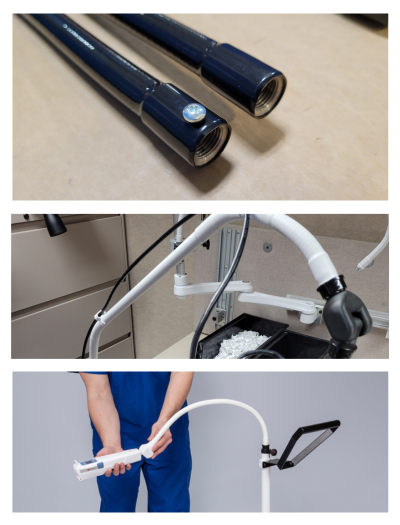
Yes, but only if the product is used as intended. If you are wondering how a flex arm holds, it’s the intense friction and tension created when you bend the arm. Essentially, the arm “locks” into place and remains stable, even when you attach an object to the end.
It is important to note that you should only mount objects that meet the weight specifications for your product. Attaching something that is too heavy will cause the flexible arm to droop.
How Much Weight Can a Flex Arm Hold?
Most standard flex arm designs can hold up to four pounds, though the maximum capacity varies by length. Typically, the shorter the length, the more weight a flexible arm can hold.
Additionally, products marketed as heavy-duty will fall on the heavier end of the weight-capacity scale, while light-duty flex arms fall on the lower end. If you have precise specifications for your application, a custom-engineered design might be the best approach to achieve your desired result.
How Do You Select Materials for a Flex Arm?
Ideal spring materials exhibit a combination of strength, fatigue resistance, and resistance to corrosion. The shaped wire is selected for its formability, wear, resistance, corrosion protection, and weight contribution. Combinations of wires are sometimes selected for their noiseless properties, which might help keep the arm silent during an adjustment.
The materials selected for your flexible arm will depend on the application and the environmental conditions at the installation site.
If you have concerns or questions about how a flex arm may hold up in different environments, discuss them with your design partner. Our team makes it part of our design process to ensure a flex arm is right for your product.
What Are End Fittings and Why Are They Important?
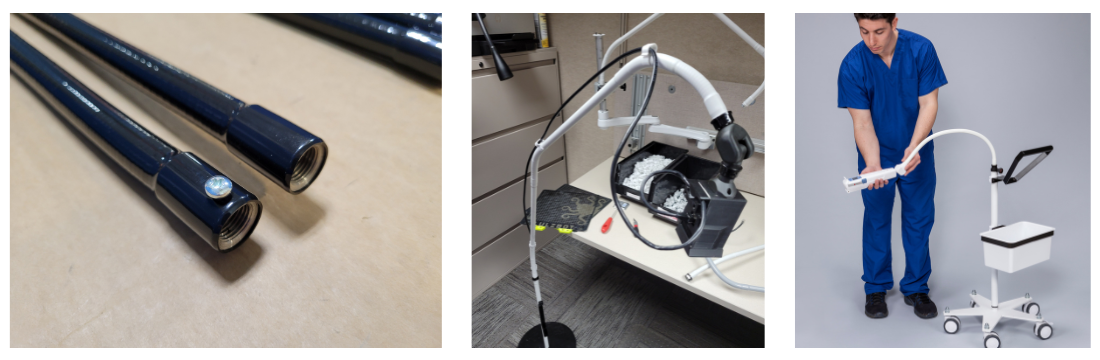
Flex arms have fittings at both ends: one for mounting the arm to a wall, desk, etc., and the other for attaching a device. Some flexible arms have threaded fittings at both ends, while others have the mounting hardware pre-attached.
When selecting end fittings and materials for a custom product, consider factors such as strength, corrosion resistance, or the ability to crimp to the flex arm. Finishes might also be considered for use in medical applications or corrosive environments.
Do Flexible Arms Need Protective Covering?
Coverings help protect the friction properties of flexible arms by creating a barrier from moisture, lubricants, dust, and other contaminants. Without that protection, the exposure can sacrifice arm strength over time.
Certain combinations of coverings can also add properties like strain relief to maximize durability — this is highly recommended for high-use applications.
What Are Some of the Recommended Uses for Flex Arms?
Flex arms are perfect for mounting small devices or objects, allowing the user to position them with only one hand. They are also thin and compact, fitting into small spaces without causing a major obstruction.
These features, along with their durability and long-term use are why they are preferred for workplaces involving precision work, repetitive tasks, or where people need an extra hand.
With stable holding power and the ability to mount virtually anywhere, flex arms offer a high level of versatility. They are suitable for use in various work environments, and the ergonomic properties can help improve safety and productivity. Here are some examples of where you can use flex arms:
- Medical Mounting Uses: Exam lights, small monitoring devices, lightweight protective shields, magnifier/light combinations, small instruments, tablets, or smartphones.
- Industrial Mounting Uses: Display screens, lightweight safety shields, tablets, smartphones, worklights, magnifying lenses, small parts, or tools.
- Home Mounting Uses: Phones, tablets, cosmetic mirrors, magnifying lenses for reading/crafts, or small cameras and microphones.
Frequently Asked Questions
For a quick recap, here are answers to the questions clients typically ask when researching flex arm options.
What is a flex arm made of?
The interior of a flex arm has a stiff, tightly wound coil metal spring and stabilizing wire, which are then covered with heat-shrink vinyl. Standard coil materials are steel, copper, and brass. Metal or durable plastic fittings are installed at each end to mount the arm to a surface and attach a device.
How does a flex arm work?
Flex arms are shaped by bending. As you bend the arm, the inside of the coil pushes outward, and the exterior pushes inward. This action wedges the spring into position. A combination of friction and tension keeps the arm in place after it is bent.
How long does a flex arm last?
High-quality flex arms can last several years when used properly. Adding a protective cover can extend product life by creating a protective barrier against contaminants that might damage the spring. It is recommended to choose a heavy-duty flex arm for high-use applications.
Can a flex arm be used in medical or wash-down environments?
Corrosion-resistant materials and a protective cover will help flex arms withstand exposure to humidity and moisture, such as in medical environments and other situations where regular sanitation is required.
Solutions Designed to Simplify Your Workspace
If you’re specifying arms for a medical device or an industrial application — where load, environment, and repeatability all matter — that’s worth a real conversation, not a catalog page. Start a custom project and our team will walk through your specs with you.
If you’re looking for a flex arm for your desk, bench, or workshop, browse our flex arm and mounting arm collection to find the length and duty rating that fits.